
The AI Lock-in: Europe is Running out of Time to Stop Google’s New AI Monopoly
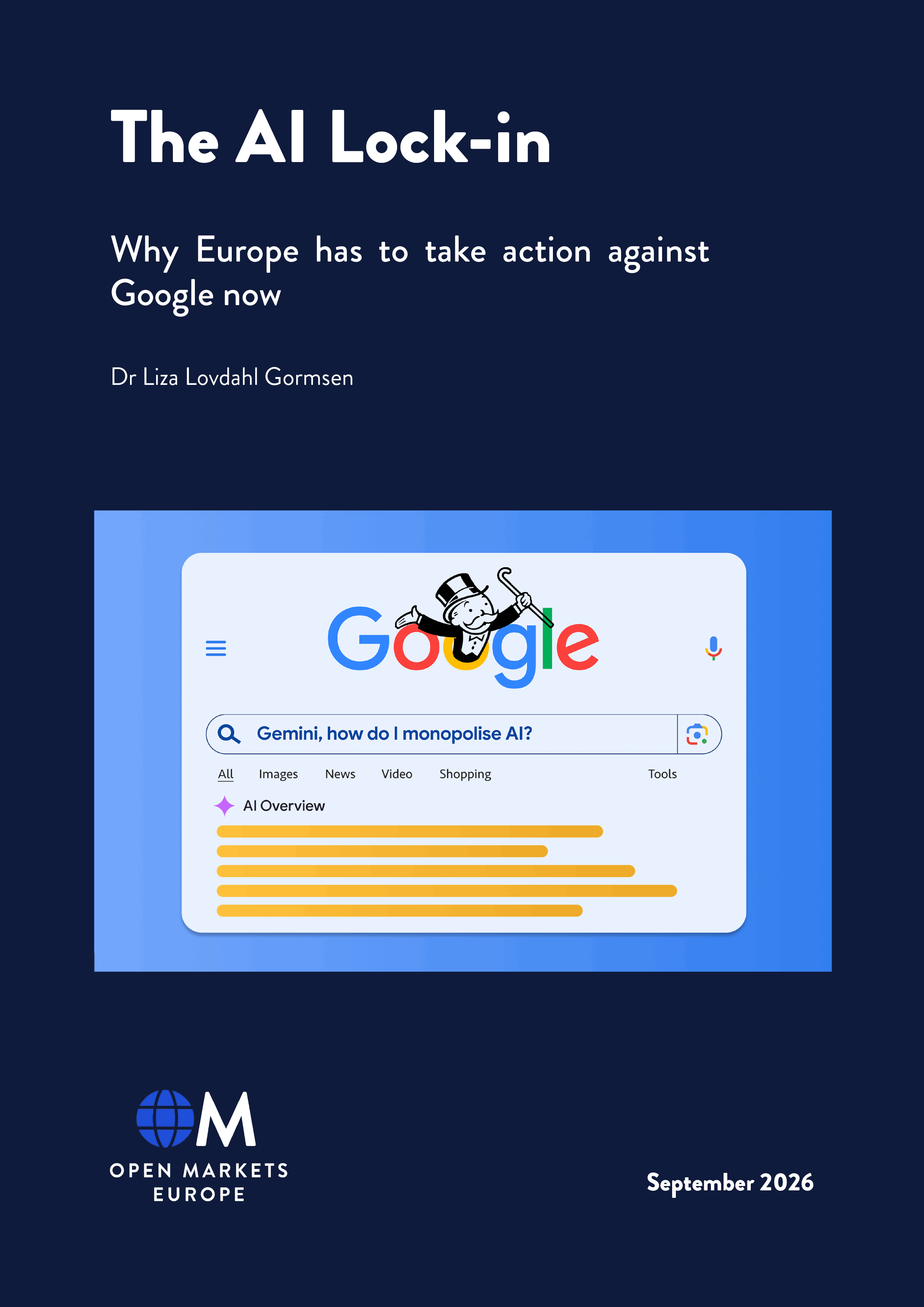
Google’s AI efforts have gone under the radar for much of this year, but the American giant has been quietly building a monopoly machine – transforming its search, mobile operating system, browser, operating system, and other monopolies into market dominance in AI.
In a new paper for OMI Europe, Dr Liza Lovdahl Gormsen lays out how Google is following the same playbook it used to monopolise search – only this time it’s applying it to the emerging consumer AI market.
While Anthropic, OpenAI and xAI are mainly focused on enterprise AI markets, Google has been focused on maintaining its monopolies on consumer services and, wherever possible, converting them into a new monopoly in the AI assistant market. Just as it did for search, Google is using self-preferencing, bundling, and exclusive access to data from Maps, Gmail, YouTube, Books and search to build a self-reinforcing moat around Gemini and use its unmatched ability to distribute it. It is thereby preventing competitors – including European rivals – from gaining a foothold.
If the EU is serious about promoting European competitiveness and reducing foreign dependence, it must move swiftly to tackle Google’s growing monopoly. Fortunately, history has taught us what works, and what does not, when it comes to preventing further monopolisation.
Section 1 shows that the remedies imposed in earlier interventions against Google in the EU (i) were ineffective, (ii) did not go far enough and (iii) were poorly implemented. This has led Google to maintain above 90% market share in search with an unparalleled wealth of user data.
Section 2 demonstrates what will happen if Google’s strategy in search is replicated in AI. The same abusive outcome that has plagued search for over a decade will continue, but with far graver consequences as the stakes extend well beyond the AI sector alone. Generative AI is set to reshape the entire technology landscape — disrupting established market structures, redefining how consumers access information and services, and redrawing the competitive dynamics of cloud computing, digital advertising, and software development among others.
Section 3 urges the European Commission (EC) to take a different approach to Google before it is too late to prevent the rollover of Google’s monopoly in search into the next era of digital markets.
Google’s success in unfairly and unlawfully leveraging existing monopolies to build new ones is well understood – the Commission’s failure to act this time round would not be.