
Exit Strategy: The EU's Tech Sovereignty Package Falls Short. Here’s How to Fix it.
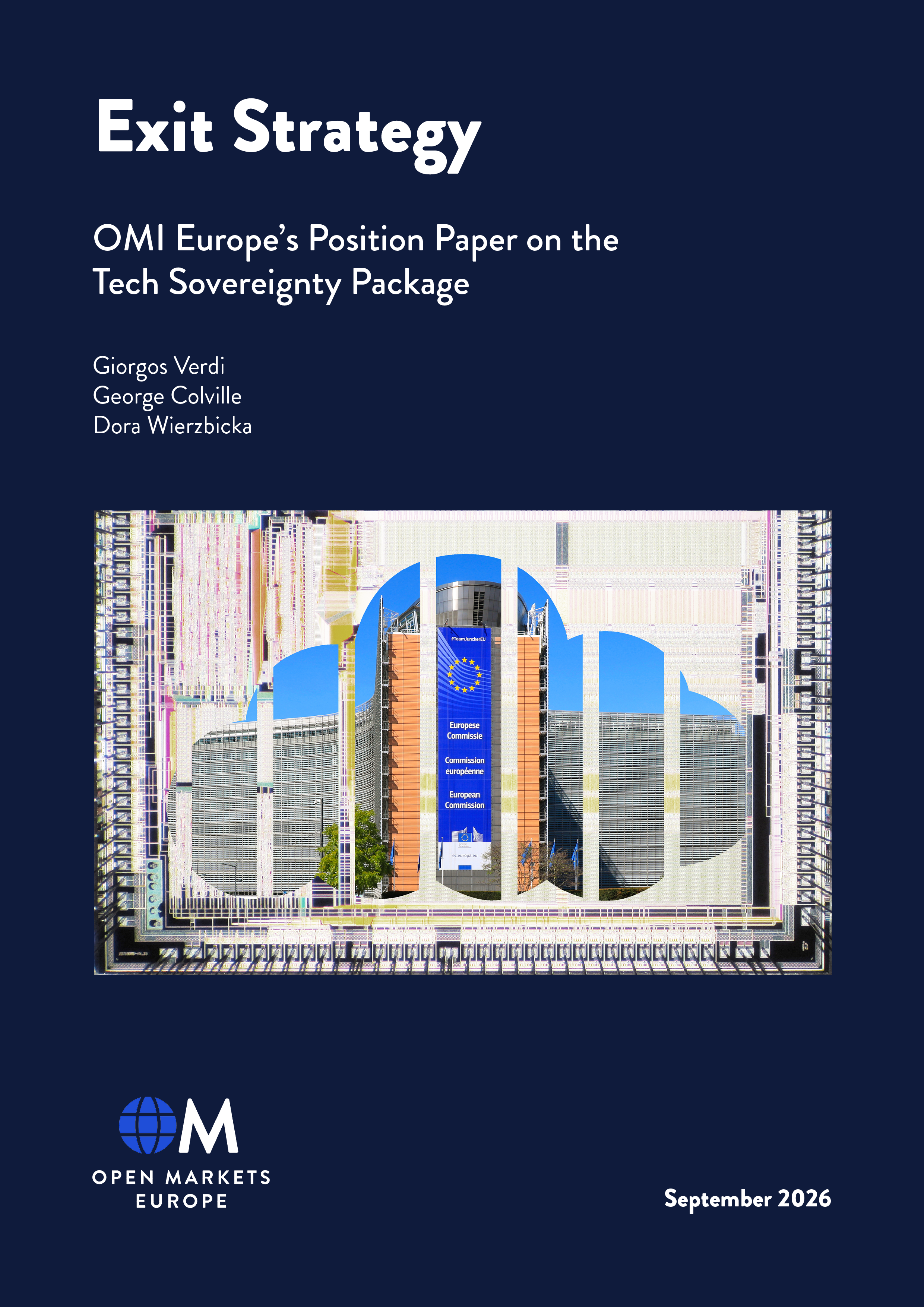
In June 2026, the European Commission published its Tech Sovereignty Package, a suite of measures which included a Cloud and AI Development Act (CADA), an Open Source Strategy, and a Chips Act 2.0. The aim: to reduce Europe’s dependence on foreign digital infrastructure.
But while the package gets the diagnosis right, its measures fall short of its own objectives.
In a new position paper, Exit Strategy, Open Markets Institute Europe makes the case for strengthening the Tech Sovereignty Package, and especially the CADA, before these are finalised. The stakes are high: every year Europeans spend €264 billion on US cloud and software services. Meanwhile, 70% of Europe’s cloud market is captured by only three firms: Amazon, Microsoft and Google.
The package could help reverse some of these trends, but only if major loopholes are closed. Member States retain broad discretion over the enforcement of cloud sovereignty rules, risking fragmented implementation. Plans to triple data center capacity risk benefiting exclusively foreign hyperscalers and exacerbating concentration, rather than supporting European alternatives. Finally, the Open Source Strategy sets out no binding commitments, so there is no guarantee it will be implemented.
OMI Europe's Exit Strategy recommendations include:
Shift enforcement of the cloud sovereignty framework from national authorities to the European Commission for major providers, and ban unsubstantiated "sovereignty" marketing claims.
Attach conditions to Data Centre Acceleration Zones to ensure new capacity strengthens European sovereignty rather than deepening reliance on US hyperscalers, and require operators to fund grid upgrades themselves.
Upgrade the Open Source Strategy's "encouragement" of open-source procurement into enforceable mandates, and revive the principle of public money, public code.
Dedicate at least €20 billion to semiconductors in the EU's 2028–2034 budget and prioritise European strength in inference chip design.
Align sovereignty standards with the Data Act's interoperability rules and the Digital Markets Act's gatekeeper obligations to break cloud lock-in for good.
Crucially, Exit Strategy insists that tech sovereignty cannot mean trading foreign monopolies for European ones. Its central aim, OMI Europe argues, should be to create the conditions for genuine European alternatives to emerge and scale – so that Europe is not dependent on any single hyperscaler, foreign or domestic.
This requires a more comprehensive approach, in which industrial policy, single market integration, capital-market integration, competition enforcement, and trade policy work together rather than in silos.